
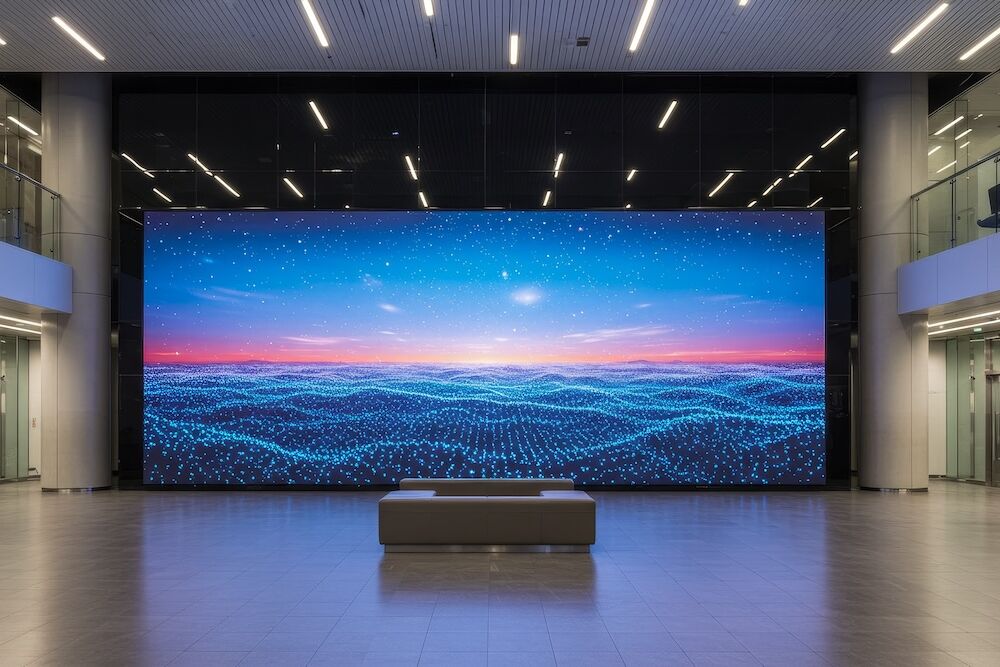
From events to retail, sports and leisure venues to public amenities, LED video walls are supersizing digital signage and graphic displays across many different locations. As we discussed in this previous post, LED walls are ideal when you want to make a big visual statement that really grabs attention. But they have the added benefit of being supremely flexible in how and where they can be deployed.
Following on from our beginner’s guide to what LED walls are, where they can be used and what their benefits are, we wanted to get down to the nitty gritty of choosing and buying a suitable LED wall solution. Large format screen solutions are new territory for many businesses. So in this buying guide, we break down the specs you should pay attention to and the features that will add genuine value.
Build & Design Flexibility
When we talk about flexibility as a strength of LED walls, we’re talking about one physical characteristic in particular – their modular construction. LED walls are not single units. Rather, they are built from multiple LED panels tiled together to create a larger whole.
This is the heart of LED wall flexibility. It means you can build them to be virtually any size and shape you like.
This modular nature does raise some practical considerations, however. One is the closeness of the fit between panels. If the join or bezel is too large, you get visible lines on the screen, which detracts from the overall quality. Acante’s LED wall systems feature an ultra-slim 0.44mm bezel, meaning the junction is less than a millimetre between two panels.
Another thing to consider is how each individual panel connects to and receives a signal from the controller unit. Our LED walls make use of daisy chain tiling, meaning they are connected in a linear sequence via a DisplayPort input and output on each panel. This radically cuts down on the amount of cabling required compared to connecting each panel to a control unit individually, and therefore reduces installation time and cost.
Image Quality & Performance
In the past, it was widely accepted that screen size was inversely proportional to image quality – the bigger you went, the poorer the quality was. But there’s little point opting for a giant display if the quality is poor. It completely undermines the wow-factor you are aiming for.
Modern LED walls have largely overcome this problem and are now perfectly capable of supporting 4K ultra-high definition (UHD) – the standard you’ve probably got on your smart TV at home. But there’s more to image quality on an LED wall than screen resolution.
One of the most important things to think about is how far away people will generally view the screen from. Viewing distance affects the optimum pixel pitch or density required to achieve a sharp image. The shorter the viewing distance, the more tightly packed you need pixels to be. The longer the viewing distance, the less dense you want pixels to be. This affects the panels you choose.
The ideal pixel pitch will vary greatly depending on whether you want an LED wall for a fairly cosy indoor space like a shop or theatre, or for a large open-air event. If you plan to use an LED wall outdoors, you will need higher brightness and contrast to offset the effects of natural light. We also supply LED panels with special anti-glare coatings to further improve image quality outdoors.
For consistent performance, a key spec is the refresh rate, or the number of times an image on a screen is updated per second. Particularly for video content, a higher refresh rate (typically 3840Hz or above) is essential for ensuring smooth motion and eliminating flicker.
Input & Control
Finally, after considering build flexibility and performance, you need to think about how you will get your content onto your LED wall. Businesses are increasingly looking for multi-functional displays that can handle different content from different sources, so flexible inputs are very useful. Our LED wall panels support HDMI and DisplayPort inputs. This means they can be used as part of a daisy-chained wall or be hooked up to an external matrix controller individually.
As for managing what a screen displays, a good LED wall should be easy to use. Features such as remote control and monitoring, content scheduling, and integration with CMS platforms allow you to update and manage displays without manual intervention. Our LED walls support TCP/ IP controls, so you can connect source devices over a local network or even the network, rather than having to wire it directly to the screen.
If you have any questions or would like to learn more about LED walls, please don’t hesitate to get in touch with our team.