
We’re getting to that time of year when people’s thoughts start to turn to summer holiday plans. But this year, a lot of Brits might be thinking twice about heading to Europe after some horror-story headlines surrounding the launch of the EU’s new automated Entry/Exit System (EES) for non-EU travellers.
On the face of it, the EES should be a triumph of technology over one of the perennial frustrations of modern living – long queues getting through security and border controls when travelling between countries. We’ve written previously about how biometric kiosks can streamline and speed up passport control – and one day even do away with passports altogether – by replacing manual document checks with instant identification of individuals via fingerprint, face or iris scans.
The EES aims to do exactly this for people arriving in EU, with the eventual aim of replacing passport stamps. At the port of entry, travellers provide a fingerprint scan and have their photograph taken for facial recognition purposes. This is meant to allow a simple ‘tap out’ process on departure, easing congestion at European airports and ports and leading to a better, faster experience for travellers when they leave. At the same time, the enhanced data capture is designed to give authorities better knowledge about who is coming into the EU, and allow them to track anyone overstaying short visa-free visits..
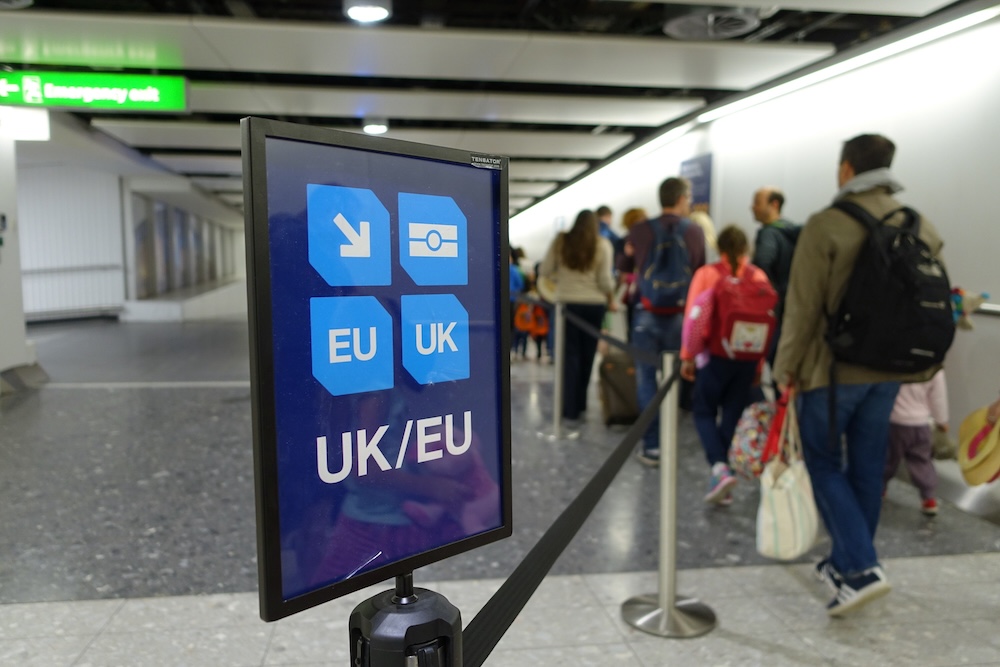
But instead of the promised streamlining and digitised convenience, the EES has suffered teething problems on a monumental scale. Since it went fully live at the start of April, passengers have reported queuing for hours to get through security, and there have been multiple reports of flights taking off without passengers who couldn’t get through in time. In one instance, a group of angry passengers stormed the runway at Marseille airport to stop their flight taking off after being told they would be left behind following delays at border control.
So what has gone wrong, what could have been done better, and what happens next?
Why biometrics need special care and attention
The issues appear to be a combination of poor planning and the sheer scale of the project. To be fair to the people in charge of the project, as kiosk vendors ourselves, the idea of rolling out an integrated identification system to every airport in Europe is a daunting one. It’s almost inevitable that there would be bumps in the road. But it sounds as if those bumps could have been anticipated and mitigated much better.
One of the biggest problems appears to be fingerprint scanners and facial recognition cameras not functioning reliably enough, forcing airports to switch back to manual checks. This should have been easy to predict. Biometric scanners are sensitive. The quality of fingerprint scans depends on factors such as finger placement, skin condition, moisture, pressure, sensor cleanliness and more. For facial recognition, image quality can be affected by lighting, blur, pose, background, glasses, facial hair, height variation and how well the camera is positioned.
Busy airports are not the best environments to control all of these things. Travellers may be tired, stressed, carrying bags, managing children, pressed for time, and also unfamiliar with exactly where to place their finger, or where to look into a camera. One of the biggest oversights in the EES seems to be reports from passengers saying there was little guidance about how to use the kiosks. With the sensitivity of biometric scanners, you have to double down on planning their implementation around real users in real environments. That includes making the interface as simple and user-friendly as possible, with clear, universally intelligible visual prompts and plain language instructions. But it also means planning for the right sensor placement, for accessibility, for lighting conditions, for cleaning and so on.
The importance of getting kiosk numbers and placement right
That feeds into a sense that there was a broader lack of rigour in the planning of the whole project. Some of the feedback from passengers caught up in long delays was that some airports seemed to have too few kiosks for the number of passengers using them. That’s a cardinal sin in any kiosk implementation. Kiosks have fantastic potential to speed up and streamline throughput, yes – but only if you have a sufficient number of kiosks for the number of users. Otherwise, you just create bottlenecks.
It’s a similar story with kiosk placement. How and where people move around a busy airport is itself a critical factor in managing wait times. Think about a busy motorway, and how often traffic can grind to a halt for no other reason than you reach a critical mass of vehicles convening on the same stretch of road at the same time. It’s the same story with queue management. And if you put kiosks in the wrong place and cause a stop in the flow at just the wrong point, it can have a huge ripple effect. A good flow through kiosks depends on careful placement combined with visibility, signage, queue design and human assistance.
Breaking down implementation into small steps
Saying all of this, we need to finish by going back to our first point – that getting an implementation at this scale right is fiendishly difficult. In the final analysis, the main cause of the issues to date is probably that the roll out happened too quickly, without enough time and space to manage the inevitable bumps in a controlled way.
Best practice on any kiosk implementation at any scale is to test equipment in integration environments, then run proof-of-concept and pilot deployments in real-world settings before scaling. This allows practical issues to be identified and resolved before full rollout, while field testing captures real performance data that can be used to reduce risk once the full implementation happens.
Our hunch would be that not long enough was spent on these preliminary stages before the EES went fully live in April. The bigger and more mission-critical the deployment, the more important it becomes to take your time and build through incremental steps.
The good news is that time is often a great healer when big tech projects get off to a bad start. Whether the kinks are ironed out in time for everyone’s summer holidays, we’ll have to wait and see.


