
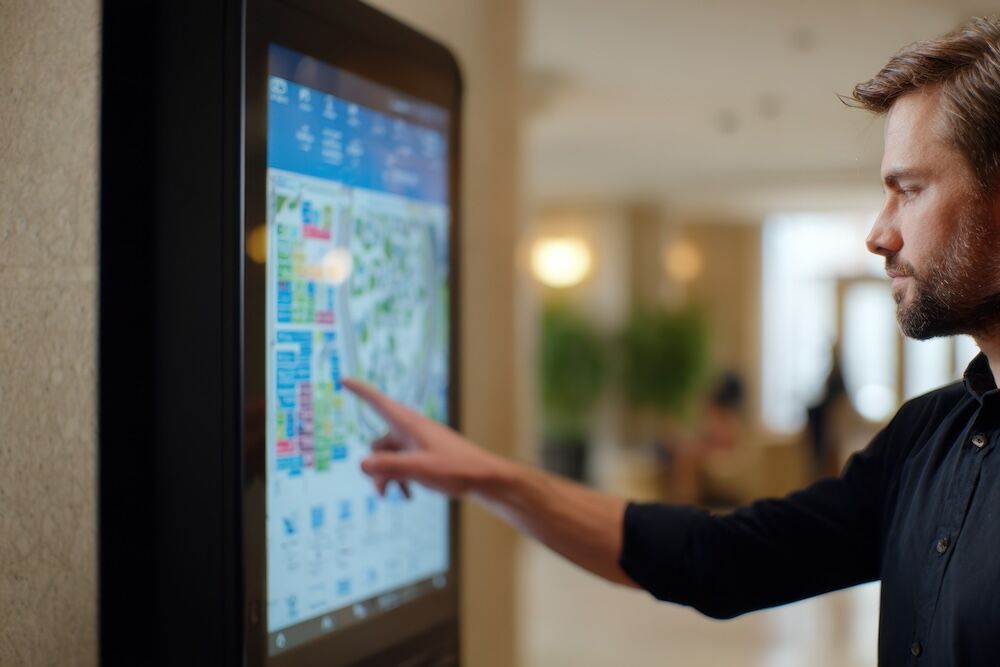
Anyone who has tried to get an appointment with their GP recently knows that health services aren’t always running at their smoothest right now. The reasons are many and complex, and certainly far beyond the scope of this blog. But there is one strand we can tug on a little – the digitisation of healthcare. And more specifically, the role kiosks play in that.
As populations grow and age and the increasing demands placed on health services lead to stretched budgets, staff shortages and creaking infrastructure, digital tech holds the promise of helping providers operate with greater efficiency, speed and scale. But it’s fair to say, even with innovations like digitally centralised health records, patient-facing apps, smart appointment systems, and a whole galaxy of highly innovative MedTech inventions, the promise hasn’t quite come to fruition as yet.
Why? Part of the explanation might be the fact that a lot of healthcare digitisation has gone down the self-service route. Got a sore throat and runny nose? Why not run your symptoms by an AI bot in an app? Answer a few questions, and they’ll either book an appointment to see a doctor, or help you buy some over-the-counter medication.
It’s a great idea in principle for easing the load on overstretched services. But putting aside the fact that appointment booking systems aren’t quite up to being handed off to AI automation yet, there is another considerable barrier – patient trust. Managing your own health isn’t like paying for groceries or ordering a takeaway. Health issues scare people. They want reassurance from an authority they trust, not to be left to fend for themselves with an app and a chatbot.
Building trust in self-service healthcare
Kiosks can help to bridge that trust gap in self-service healthcare. Psychologically, there’s a world of difference between self-diagnosing via an app when you’re anxious and alone, and using a kiosk at a surgery or clinic. You might go through exactly the same steps. But you’re in a place of authority and safety. And you can reach out for human help if you need it.
The numbers suggest that the healthcare industry is catching on to kiosks as an important facilitator of medical self-service. The patient kiosk market is expected to grow by close to 20% from 2024 to 2025 alone. And then almost double in size by the end of the decade.
The use cases for kiosks in healthcare are expanding, too. Obvious applications in surgeries, clinics and hospitals include patient intake and triage, allowing patients to check in for appointments, complete health questionnaires, and perform initial symptom checks etc. Modular kiosk design makes it easy to integrate medical diagnostic tools such as blood pressure monitors, thermometers, even cameras paired with computer vision AI for initial visual examinations, making it possible to collect clinical data before a patient sees a practitioner. All of this contributes to efficient patient flow and prioritisation of urgent cases.
Post-appointment, kiosks can be used for booking follow-ups, or printing and paying for prescriptions, further taking the load off the reception desk.
We’re also seeing more and more healthcare kiosks being placed outside traditional clinical settings to improve choice and accessibility. For example, more and more are cropping up in pharmacies, providing a convenient option for quick consultations and immediate prescription fulfillment. But they are also being rolled out in workplaces, community centres, leisure centres and local stores, all to provide people with convenient access to health advice, diagnostic and appointment booking services.
The trend reminds us of an important truth about technology. Yes, it can work wonders in hard-pressed sectors like healthcare that are having to find ways to deliver more with less. But user preferences and context are everything. What people don’t feel comfortable doing on an app, particularly in the context of health, they are happy to do in a kiosk in the right setting.
Contact us
If you’re exploring how kiosks could help improve access, efficiency, and patient trust in your own healthcare setting, we’d love to talk. Our team works with healthcare providers, pharmacies, workplaces, and community organisations to design kiosk solutions that are secure, intuitive, and built around real patient needs. Get in touch with us today to discuss your challenges, see what’s possible, and find out how kiosks could play a role in bridging the gaps in your healthcare services.