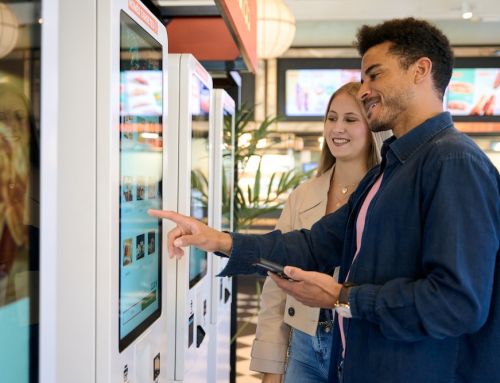

Self-service kiosks are hardly the new kids on the business tech block anymore. But you wouldn’t know that by looking at the market growth forecasts.
There’s definitely a new kid energy about the latest projection that global kiosk sales are going to hit $10bn by 2031 – a cool combined annual growth rate of 7.8%. That’s testament to the staying power kiosks have in an age when continuous innovation can make yesterday’s hot new thing look old and jaded with astonishing speed.
So what is it that’s not only keeping kiosks relevant, but is expected to drive such healthy growth for the next half-decade at least? Here’s our take on four factors behind this ongoing success story.
AI Integration
Let’s start with the one that everyone saw coming. AI carries the promise of levelling up pretty much every type of tech imaginable, including kiosks. With AI-powered automation, data analytics and interactions, kiosk experiences will become even more efficient, convenient and responsive to what each user needs. And as we all know, popularity with users drives adoption.
In retail, for example, AI has the potential to solve current self-service pain points like the well-documented usability and security issues with supermarket self-checkout. Computer Vision AI is being developed to scan whole baskets of goods instantly, and also look for signs of suspect behaviour to reduce shrinkage. AI will also power a new era of personalisation in self-service, from making up- and cross-sell recommendations based not just on the items customers bring to checkout, but on what they have been browsing in store. Even little touches like automatically moving to contactless payment by spotting that a customer has taken a card out their wallet make a difference to the overall experience.
Smart Cities Coming of Age
Smart Cities have been talked about for a long time. How ‘smart’ cities have actually become is open to date, even though the global market for related technology is estimated to have passed the $600bn mark in 2023. However, on the back of – you guessed it – advances in AI, that is projected to balloon to a massive $4.6 trillion by 2032.
Smart city technology covers everything from integrated public transport and traffic management systems to utility supplies and public safety. The opportunity for kiosks comes from the fact that smart cities also incorporate digital public services – i.e. providing opportunities for citizens and visitors to look up information, request assistance and access services as required. In short, the more municipalities digitise their public infrastructure, the more kiosks we’ll see around our cities.
Improved Interfaces
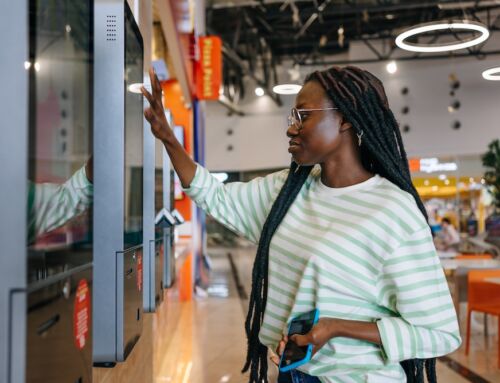
It’s hard to overstate the role that touchscreen technology has played in the success of kiosks to date. In a way, touchscreen kiosks burst onto the scene at just the right time, in the wake of the smartphone revolution as people’s lives were being transformed a tap and a swipe at a time. The convenience and simplicity of touchscreen interfaces has been a huge factor in making self-service feel natural and accessible to so many people.
Touchscreen technology is still improving, from more durable designs allowing kiosks to be deployed outdoors, to improved gesture response and innovations like by 2032. which lets users literally feel when, say, an error has been made.
At the same time, we’re also seeing voice interfaces become more and more popular, giving users the option to engage with kiosks via spoken word, not just their hands. As well as giving users more choice, voice UI will help drive growth in kiosk use by making information retrieval more ‘conversational’, allowing people to ask questions in a natural way and get more precise or detailed answers through dialogue.
Biometric Tech Reaching Maturity
Finally, we also see biometric tech being a huge part of the kiosk story over the next five years. Fingerprint, facial recognition and iris scanners are already common in kiosks for purposes like ID verification and access control. We’re seeing huge growth in biometric kiosks being used at airport check-in and security, for example.
Once biometric tech reaches full maturity – including guaranteeing watertight security for how personal biometric data is stored in all scenarios – we can expect biometrics to become the default for all forms of personal identification and authorisation. And we’re not just talking passports and ID cards with biometric data stored on them – we’re talking about biometrics replacing ID and even payment cards, with verification coming through a tap of your finger or a glance into a camera alone. This will revolutionise everything from payments to border control, premises access to security. And it will create untold new opportunities for deploying biometric-enabled kiosks.