There’s no shortage of theories explaining why self-service technology has become such a phenomenal success. They cover the obvious benefits to businesses of offloading core operational aspects of service and transactions to customers and end users, reducing workloads and labour pressures in the process.
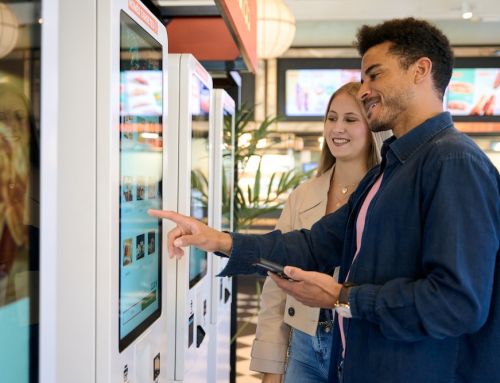
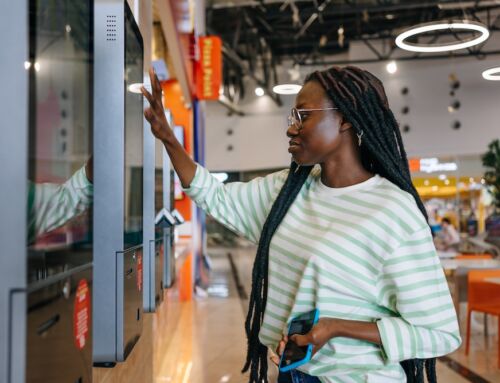
But any theory of self-service success also must acknowledge the plain fact that people like this added responsibility. They like the autonomy of using a kiosk to order a burger and fries rather than having to relay what they want to a cashier. They like the empowerment of taking their time and customising their order. They like the flexibility of not having to wait behind a queue of laden trolleys in a supermarket when they only have a needful of items in a basket to pay for.
Without customer buy-in, self-service would not have taken off the way it has. And we can see the plain evidence for people’s preferences for self-service in their online behaviours as well as in the rise of kiosk use.
But this raises an important question. Because, under the influence of AI, self-service is changing. As AI evolves to be more autonomous in its decision-making and action-executing capabilities – what we now refer to as agentic AI – the latest generation of ‘smart’ kiosks are no longer just passive endpoints built to let users take control. Agentic kiosks are capable of running these interactions, making suggestions, steering customers towards a desired goal, the way a salesperson would.
In a sense, this is flipping the self-service experience on its head. What happens to customer autonomy and empowerment when we’re dealing with a highly intelligent, proactive, goal-driven machine with its own agenda? At what point does a kiosk interaction morph into dealing with a robotic substitute for a human agent? Are people ready for that change? What are its benefits?
Machines taking control of the conversation
Most human-machine interactions are based on a person giving the machine an instruction. That’s even the case when we engage with the most common types of AI in our lives right now, from chatbots to voice assistants to generative AI tools. Asking ChatGPT or Alexa a question is giving an instruction to retrieve a certain type of information. Even when the power of large language models (LLMs) allows AI tools to carry on what feel like very sophisticated conversations with us, the interactions still follow a fundamental formula – we speak, and the AI reacts based on its interpretation of what we want.
Agentic AI is different. AI agents are not programmed to give good responses. They’re built to achieve specific goals. That means they are not just using what you say as a prompt. They are using it as another source of data to help problem-solve their way to the desired goal. And that means they are making decisions independently with a view to achieving that goal.
Let’s consider the example of a sales kiosk. We all know from high-profile success stories like QSR that kiosks were a fantastic vehicle for upselling even before AI, simply by running basic rule-based automations that remembered to recommend the best-selling accompaniment or upgrade for every meal ordered, every single time. Conversational AI has provided additional interfaces. Instead of tapping images and getting pop-up suggestions, you might get a chatbot asking if you need any help, or you can deliver your entire order verbally.
Here’s what happens when you add an AI agent to that kiosk. The AI’s goal can be exactly the same as those simple rule-based automations that have proven so effective – increase the order value. But an AI agent isn’t bound by simple if-then logic. It can approach the challenge of getting each customer to buy more from any number of angles. It can be proactive about it, asking a customer for preferences or dislikes. If a customer asks to leave mayo and lettuce off their burger, an AI agent might, completely off its own bat, ask if there are any other toppings they’d like instead.
Agents of personalisation
An agentic kiosk offers a different kind of experience – smarter, more proactive, more attentive. We might say more like getting service from an intelligent robot than self-service. Does that not threaten the whole dynamic?
Perhaps not. Because a smart kiosk able to gather information from us in the moment of interaction and adapt its responses accordingly is capable of something that is very, very sought-after among businesses and consumers alike – truly individualised personalisation, or what has come to be known as ‘hyperpersonalisation’.
Given a choice between self-service autonomy and personalisation, the smart money would be on most people opting for personalised experiences every time. As we explored in this blog, people are more interested in choice or service options rather than being wedded to self-service in particular anyway. A comprehensive 81% of consumers are clear, on the other hand, that they prefer companies that offer personalized experiences.
The ability to provide personalised experiences, even for ultra-smart agentic AI, depends on how much customer data the AI has to work with. Again, this is something people appreciate and are comfortable with. Half of consumers feel giving companies access to more personal data is a fair exchange for better experiences. This is why there’s so much talk about the importance of companies collecting first-party data directly from customers.
First-party data collection is a tougher proposition for bricks-and-mortar traders than online. But there are ways this can be facilitated via a kiosk. You can, for example, equip kiosks with cameras linked to computer vision and sentiment analysis AI so they can ‘read the room’ as a customer uses the machine. With facial recognition technology, you could link this to membership or loyalty schemes, or do this via wireless smartphone connections to a member’s app. Combined with a suitable AI agent, you can have kiosks welcoming customers by name, asking how they enjoyed their last purchase, asking if it will be the usual or if they’re after something different today.
With all the technologies required readily available, and the lure of hyperpersonalised experiences within reach, it’s surely inevitable that self-service will head down this path. Kiosks will become intelligent agents, capable of simultaneously responding to the nuanced needs and preferences of every individual customer and pursuing their own programmed agenda, changing the nature of the interaction from human-to-console to something more akin to human-to-robot. It will certainly change the dynamic of self-service as we know it. But perhaps to the benefit of all parties.