
A recent survey of large retail chains in the US produced a remarkable stat about self-service technology adoption. It found that retailers classified as being at a mature stage of self-service adoption were now running, on average, 3.5 distinct self-service types.
The ‘types’ covered in the report reveal a clear bias in focus towards supermarket/grocery and other large retailer formats – self-checkout POS terminals, self-ordering kiosks, scan-and-go (both via smartphone apps and provided handheld scanners) and smart carts with integrated digital screens.
But while some of these formats might not be widely transferable across retail categories, the reasons given for why retailers are doubling and tripling up on self-service options very much are.
Embedding self-service across the shopping journey
On the face of it, all of the types listed above offer different routes to the same end – putting the customer in charge of the transaction process, whether it’s scanning items at a POS kiosk, at the shelf as they pick items up, or by placing them into a digitally enhanced trolley. Indeed, the report found that the number of transactions going through self-service among mature adopters (64%) was more than double that going through staffed checkouts (30%).
But when asked about their self-service choices, the responses of decision-makers surveyed for the report show they are thinking far beyond checkout. In fact, the primary reason why retailers deploy multiple self-service options is because they no longer see it as purely a checkout tool. They want to embed self-service across the shopping journey.
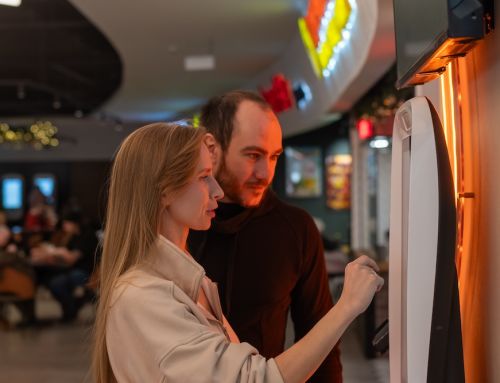
Take the example of retailers having dedicated self-checkout lanes or POS kiosks, but then also deploying what the report calls ‘self-ordering kiosks’ elsewhere in the store. We could actually question the term chosen by the report’s authors for this second group of kiosks here. Because while it is increasingly common for supermarkets and big box retailers to have kiosks dotted around that let customers place orders and pay for various additional services and concessions, there’s another even more important use for these ‘non-checkout’ kiosks. Information.
How self-service supports purchase decisions
Retailers are turning to self-service to resolve specific friction points in the shopping journey that all boil down to empowering customers with information. As per the report’s findings, 67% of retailers say they want to give customers more help finding products in store. 65% also feel they could give more assistance with decision-making, by making product information more accessible, or facilitating comparisons.
Kiosks and other self-service formats like handheld scanners are perfect for this role. Instead of looking for an assistant to help locate an item they can’t find, customers can walk to a conveniently located screen and search for it themselves. They can also check product details, stock availability, pricing comparisons – all information that feeds into a decision to buy – as they browse. It helps make the whole shopping experience smoother and more convenient, with less hurdles (I have a question about a product and no obvious answer) and less frustration (and there’s no one around to ask).
In truth, the expansion of self-service in retail is not about the different formats or how many a particular retailer might deploy. It’s about recognising the different roles self-service technology can play across the customer journey, and using it accordingly.