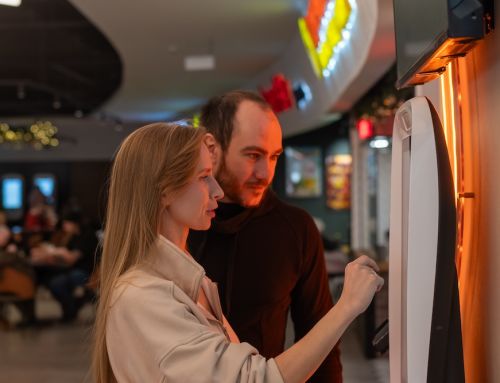
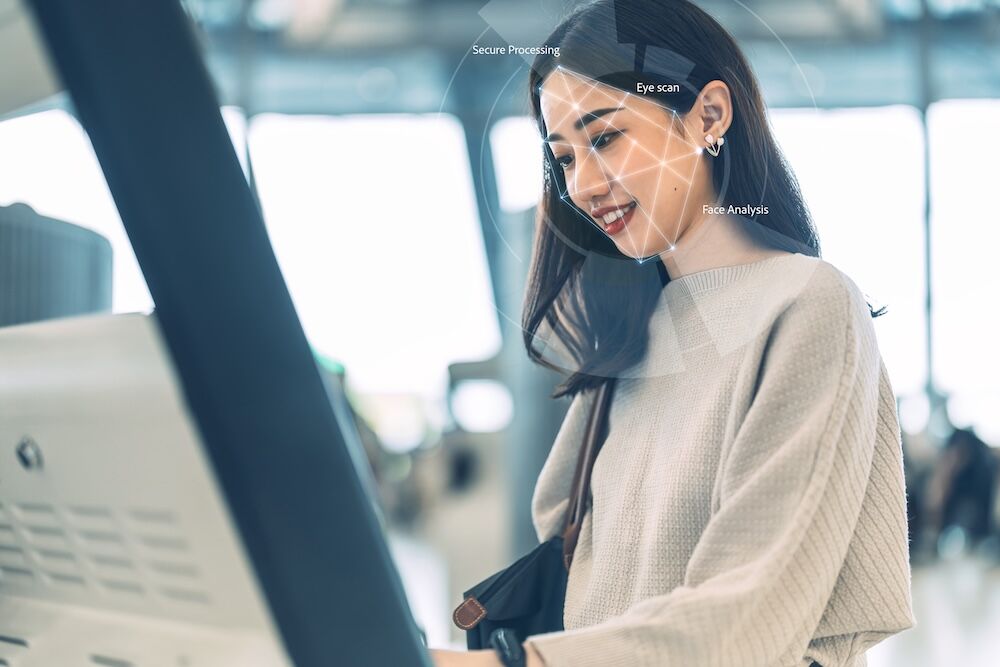
Here at Acante, it’s a source of pride that we’ve long been ahead of the curve on what we like to call ident kiosks – self-service kiosks used primarily for identification purposes.
While other manufacturers and vendors concentrated on self-service checkouts and customer-facing information points, we were early to recognise the potential of kiosks for personnel identification, access control, security authorisation and more.
As part of that, we were also early to the party on incorporating biometric technology into our kiosks.
As we were always confident would happen, the rest of the world is catching up. ID kiosks are now a major growth category in the wider kiosk market, with sales of biometric kiosks expected to see double digit annual growth in value for the next 10 years.
This is because the value of being able to verify the identity of a person can be applied to so many different use cases – more than taking payments, perhaps more even than dispensing information. We’ve mentioned classic examples like controlling access to buildings and security authorisation. But quick, seamless, automated ID verification has countless applications, from registering patients for medical appointments to passport control, guest check-in at hotels to proving membership of clubs or loyalty schemes.
Perhaps most exciting of all, there’s the tantalising possibility of biometric authorisation one day replacing payment cards, tickets and other types of token used in person.
However, a lot goes into making automated or self-service identification work. And the stakes are high. Biometric technology itself is sophisticated, although with the rapid rise of AI, facial recognition and pattern matching from fingerprint scanners has come on leaps and bounds.
But even then, creating a workable identification system requires more than simply adding biometric capabilities to an existing kiosk.
Design around the verification process
We wrote recently about the massive teething problems being experienced by the EU’s new automated Entry/Exit System (EES) at airports and other border points. This is a classic example of why identity verification systems need to be designed with utmost care and consideration of factors like the environment, the flow of people through the system, user volumes and more.
The EES uses both fingerprint scanners and facial recognition cameras to identify travellers as they arrive in the EU. It makes sense to cover all bases. But, presumably for security reasons, it uses four-finger scanners. Accurate capture of four fingerprint images is not easy, and not the sort of thing that lends itself to environments where you want to move large numbers of people through quickly to avoid queues. There are also reports of the facial recognition cameras being affected by lighting levels and glare. That’s a matter of poor placement.
Because identification can be applied to so many different use cases and environments, you really have to think about each one individually. You need automated identification to be secure and robustly reliable, of course. But you also need to think about speed and flow and efficiency, too. The big issue with the EES is that, as things stand, it’s no more efficient than old-fashioned passport control.
It’s not all about biometrics, either. Identification has worked for a long time without biometric technology, relying on documentation. If you want to introduce self-service identification, it’s a valid question to ask whether biometrics, given its particular challenges, is always the right answer. Would a simple document scanner work best? Or an RFID chip reader?
Make the hardware adaptable
The great thing about kiosks is that you don’t have to lock yourself into either-or decisions on what type of touchpoints and operations you include. With modular kiosk builds, you can mix and match. In its defence, the EES system tried to do this by having both fingerprint and facial recognition scanners. But it could have also kept standard passport scanners as a fallback option in case there were issues with the biometric options. And therefore saved the hassle of having to revert to manual checks with an unprepared workforce, which is what has caused so many of the delays.
At the same time, identity requirements are likely to change over the life of a kiosk. We’re living through the transition from document-based to biometric ident systems right now. Biometric technology will keep evolving. And organisations will decide that they need different solutions as their needs change over time.
Modular kiosks allow systems to adapt and evolve without replacing entire terminals. Components can be selected to suit current needs, or even to roll out a minimum viable product in the short term, giving you time to develop a more sophisticated version. The key point is that modular kiosks can change or expand as services, regulations and user expectations evolve. This is probably more important to ident kiosks than those used for any other purpose.
The technology used to manage self-service identification is unquestionably important. But successful systems depend on how that technology is brought together, positioned and supported. The real challenge is not simply recognising a person. It’s designing a process people can complete securely, confidently and with as little friction as possible.